
A late Cold War movie to savour…
Directed by: Steve De Jarnatt Starring: Anthony Edwards, Mare Winningham, Mykelti Williamson, Jon Agar, Lou Hancock, Kurt Fuller, Kelly Jo Minter, Brian Thompson, Denise Crosby
To sum up the Cold War briefly would be to say that 1945 to 1989 saw a clash between two political ideologies held by the world’s two biggest economic and military powers who, together, had worked for the previous four years to end the Second World War. That War was ended in two separate ways: by Allied British and Russian troops marching into the heart of Berlin, forcing Hitler to take his own life and cause Nazi Germany to surrender in May 1945, and by the USA dropping two atomic bombs onto the cities of Hiroshima and Nagasaki forcing the indomitable Japanese to sign a treaty of surrender to officially end the war in September 1945. The dropping of Fat Man and Little Boy led to a post-war arms race between the now opposing allies of the Communist USSR and the Capitalist USA. At the heart of this arms race was the continued development of atomic weaponry which, if used, could lead to the inevitable ‘World War III’ and a mass destruction of human life. The constant threat of nuclear warfare formed the main undercurrent of a war that spanned the majority of the 20th century where words took precedence over violence.
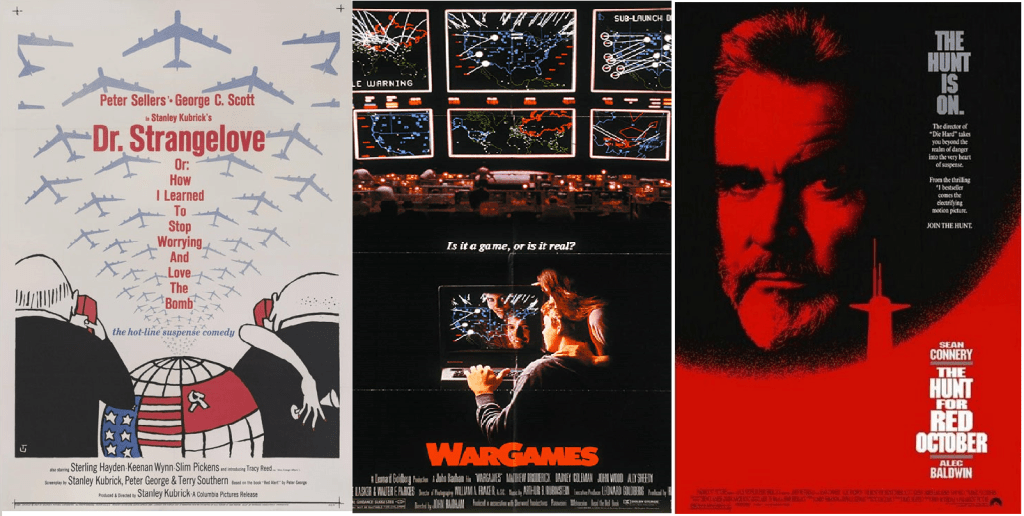
Due to the length of the conflict, there can now be considered a large sub-genre of filmmaking released between the late 1940s and the late 1980’s that could considered ‘Cold War films’, in the same way that ‘Vietnam war films’ and ‘WWII films could be seen as potential subgenres. With the subgenre of ‘Cold War films’, there are a number that concern themselves with the threat of nuclear war. The concept was brilliantly satirised in Stanley Kubrick’s Doctor Strangelove (Or How I Learnt To Stop Worrying And Love The Bomb) where a rogue and insane US general orders a nuclear strike on Russia all while the President, his advisors and the Russian ambassador try to stop the attack from happening. Despite such a dark and bleak premise, Kubrick’s anti-war film is now known as one of the greatest comedies ever written. Another example comes from 1984’s WarGames, where teenaged Matthew Broderick accidentally hacks into a US military supercomputer when searching for a video game. He accidentally causes the computer to run a nuclear war simulation, leading NORAD to believe that Russian missiles are incoming. When the return strikes are called off, the computer continues to strike, not knowing the difference between reality and simulation. Therefore, Broderick and NORAD have to stop the attack from going ahead. Similarly, the 1990 film The Hunt For Red October based on the 1984 Tom Clancy novel, details a rogue Russian submarine captain named Ramius who wishes to defect to the US side. The problem arises when US intelligence find that the sub contains nuclear missiles. It then up to CIA analyst Jack Ryan, who has uncovered this truth, to convince the US Navy in time before nuclear war accidentally happens.
What should be noted is the that the latter two examples are set in the 1980s. After the decade of détente ended in 1979, the ‘Second Cold War’ began with tensions being reawakened after the Soviet invasion of Afghanistan that very same year. In the early 1980’s, the Russian stockpile of nuclear weapons had outstripped the United States. In retaliation, US defence spending reached its ‘peacetime’ high with ballistic missiles being placed 10 minutes from Moscow within West Germany. Academic Michael Cox stated in 1990’s Beyond The Cold War: Superpowers At A Crossroads? that “the intensity of this ‘Second Cold War’ was as great as its duration was short”. This growing anxiety about the once-again impending threat of nuclear war was replicated in 1980’s filmmaking, and there is a forgotten film from this era that gets straight to the heart of it, 1989’s Miracle Mile.

Miracle Mile was written and directed by Steve De Jarnatt, who had previously worked on 1983’s Strange Brew (an film adaptation featuring the SCTV characters Bob and Doug) and 1987’s Cherry 2000, a forgotten film starring Melanie Griffith. The film starred two rising stars as its lead characters, Anthony Edwards and Mare Winningham. Edwards had earnt worldwide recognition for his portrayal of Nick ‘Goose’ Bradshaw, Tom Cruise’s wingman, in 1986’s smash hit Top Gun. Mare Winningham had been a member of Hollywood’s ‘Brat Pack’, notably starring alongside her compatriots in 1985’s ensemble coming-of-age drama St Elmo’s Fire.
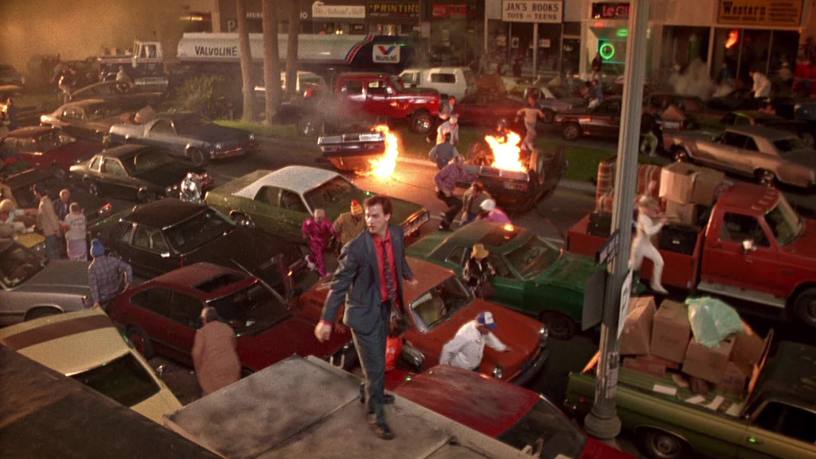
In Miracle Mile, we are introduced to Harry Washello (Edwards), who has just met and started seeing Julie Peters (Winningham), who he perceives to be the girl of his dreams. After spending time together one day, the two agree to meet again at midnight after Julie has finished working at the local diner. However, while taking a nap, the hotel which Harry is staying in undergoes a power cut, causing him to miss his date with Julie and wake up three hours later. When he later visits the diner to find Julie, he answers a ringing payphone. On the end, a frantic man looking for his father tells Harry that Los Angeles is about to be hit by nuclear missiles in 70 minutes time. After hearing the man being killed on the other end of the phone, Harry now has to inform the people around him of the impending nuclear disaster, find Julie and most importantly, find a way to leave Los Angeles and the USA before time runs out.
Miracle Mile is a fantastic thriller that deals with the absolute terror instilled in ordinary people by the impending threat of nuclear war. After Harry receives the original phone call, the film’s action plays out in real time, following Harry and Julie as they try to survive amidst the panic and chaos filling the streets of Los Angeles. Civilians shoot other civilians, police cars are stolen and crashed into shops, police officers not curbing the ramping violence. People losing their minds over such an earth-shaking event.
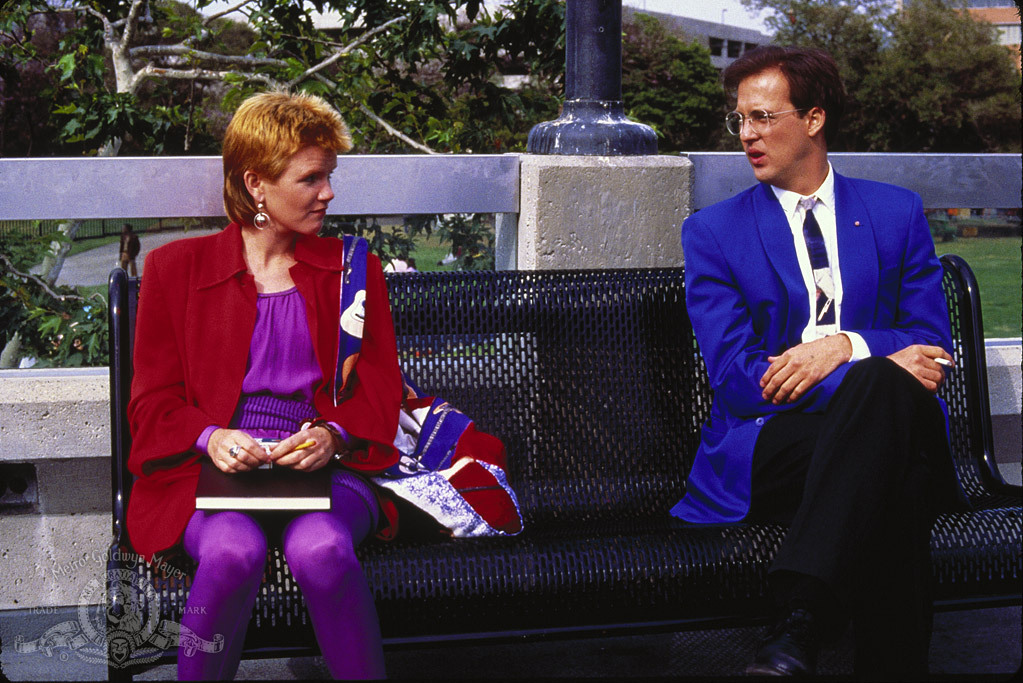
Within this panic is a beautiful love story between Harry and Julie that unfolds as the film progresses and doom draws nearer. The chemistry between the film’s lead actors is brilliant as these two normal people who have just found each other decide that they do not wish to leave one another considering the dire circumstances and the emotions these two feel for one other is evident as the minutes tick down. From the moment the two are featured on-screen for the first time, you can tell that this romance is destined to last. Besides the leading actors, able support is provided by Mykelti Williamson (Forrest Gump), Kurt Fuller (Wayne’s World) with John Agar and Lou Hancock as Julie’s grandparents who use their last hour together as an opportunity to rekindle their love for one another.
Miracle Mile was first shown at the Toronto International Film Festival in 1988 before being given a full release on 19th May 1989. The film had a poor opening weekend, opening at 17th at the US box office, grossing $341,401. The film would improve to fifth the following week, but would soon fall away, grossing only $1.1 million against its $3.7 million production budget.
This is a forgotten film I would definitely recommend. The excellent direction by Steve De Jarnatt, the performances of the entire ensemble and the excellent ‘real time’ cinematography really gives the viewer a real sense of terror as all hell breaks loose in the midst of a nuclear attack. Seek this film out and see for yourself.
 forgotten-media.com