
The interesting origins of one of the most successful superheroes…
Starring: Luke Evans, Rebecca Hall, Bella Heathcote, JJ Feild, Oliver Platt, Connie Britton Directed and written by: Angela Robinson
In 2017, a superhero film featuring a female lead and a female director saved relieved the long-standing embarrassment from DC Comics’ underwhelming answer to the all-conquering Marvel Cinematic Universe (MCU). Following the dual major critical disappointments of Batman v Superman: Dawn of Justice and Suicide Squad in 2016, Wonder Woman was just the tonic that the struggling franchise had been crying out for, a beacon of light amongst stories of reshoots to make an unnamed film ‘funnier’ to all that occurred within the 151 minute confines of BvS: DOJ. Wonder Woman earned widespread critical acclaim for the work of director Patty Jenkins and confirmed the star status of Israeli actress Gal Gadot, earning $821 million at the box office. The American Film Institute even named Wonder Woman as one of its top ten films of 2017. That same year, a film with a familiar subject matter was released with much less fanfare featuring two female leads and a female director and writer. However instead of this film featuring the origin story of how Wonder Woman discovered her powers and managed to become the superhero we all know and love, this film details the origin story of the man who created Wonder Woman and how through rather unusual circumstances, the idea for the world’s most famous female superhero was formulated.
The film for which I am alluding to id Professor Marston and the Wonder Women. The film was directed and written by Angela Robinson, who had previously directed the cult film D.E.B.S. (2003) and the Lindsay Lohan star vehicle Herbie: Full Loaded (2005), in addition to working as a writer and producer on The L Word (2004-09), True Blood (2012) and the failed 2011 reboot of Charlie’s Angels (which may be the subject of a later review). The film was released on 13th October 2017, 4 months after its more notable sister film, by Annapurna Pictures and Sony independent studio Stage 6 Films. As described by the title, the film’s subject pertains to that of the aforementioned Professor Marston and his connection to the creation and subsequent history of Wonder Woman.
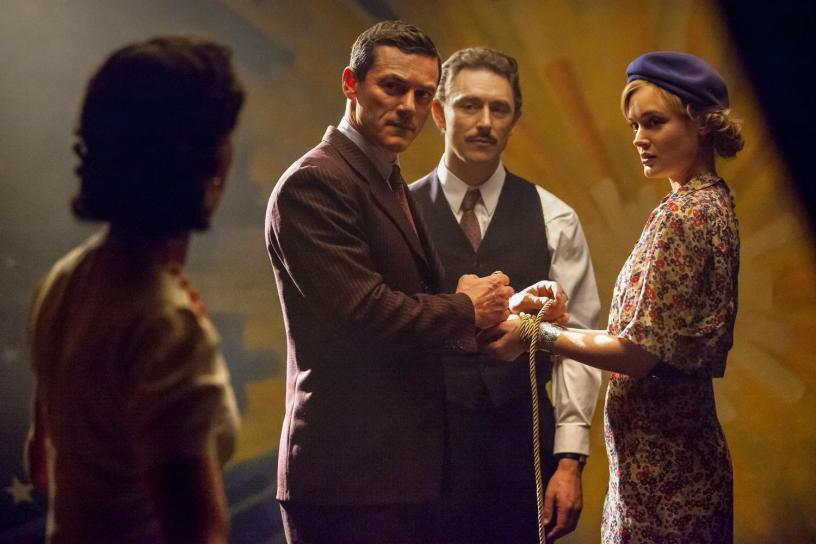
In 1928, William Moulton Marston (played by Luke Evans) is a professor of psychology at Radcliffe College, the female coordinate institution of Harvard University. Professor Marston’s particular area of research is that of DISC theory and how this theory can be used to assess human behaviour through its four component parts of Dominance (D) Inducement (I) Submission (S) and Compliance (C). His aided in his research by his wife Elizabeth (Rebecca Hall) as the two start to develop one of the first lie detector polygraph tests. One day, William hires one of his psychology students Olive Byrne (Bella Heathcote) as his research assistant and she aids the two in their polygraph tests. However, its is found through these polygraph tests that Olive has fallen in love with both William and Elizabeth and it is soon proven that the feelings are mutual. The trio begin to engage in a polyamorous relationship. After word about their relationship gets out, William and Elizabeth are fired from Radcliffe and struggle for work. This problem is compounded when Olive reveals that she is pregnant with William’s child as a result of their relationship. For the next decade, the Marstons and Olive continue their polyamorous relationship, hiding it in plain sight while sharing a house in suburban community, trying to keep their relationship a secret from the outside world and even their own children, fearful of what might occur if their tryst were to be discovered.
Through this time period and through some experimentation in their relationship, William develops the idea for an Amazonian superhero, applying his ideas of DISC theory to the creation of a figure who would serve as an inspirational figure for American women during World War II. Therefore, anyone wondering about some of the particular attributes and objects that form part of the core of the character of Wonder Woman, you may have your answer.

Interspersed throughout the main story of the polyamorous relationship between the Marstons and Byrne and the creation of Wonder Woman are flashforwards to 1945, where William is forced to explain his story and defend Wonder Woman in front of the Child Study Association of America, headed by Josette Frank (Connie Britton), who believe that the Wonder Woman comics are unsuitable for children due to the overtly sexual nature of the character and her armoury, including the truth lasso. Through this hearing, Marston is aided by Max Gaines (Oliver Platt), the head of All-American Publications and the publisher of the Wonder Woman issues, which have sold particularly well. It is up to William to ensure that Wonder Woman remains in publication, retaining his main form of revenue to help support the young family that he has Elizabeth and with Olive.
Professor Marston and the Wonder Women is a very good, but not great film biopic. The film is anchored by three strong lead performances from Luke Evans, Rebecca Hall and Bella Heathcote as the polyamorous leads. Most of the film’s scenes involve only the Marstons and Olive Byrne and the film’s overall quality could potentially live or die on the chemistry between the main trio. Fortunately, the chemistry fizzes between Heathcote, Evans and Hall, making their groundbreaking relationship appear believable and the sexual tension is evident in the scenes before the three start to engage sexually. Rebecca Hall’s performance is especially brilliant as she plays the academic whose snide comments towards Olive and others in account to her own way of being nice. Elizabeth often acts as the spoiler in the relationship, being the one to question whether the path the three are taking is the right one to be going down, in fear that their secret will eventually be uncovered and their lives will be ruined. The film is prevented from reaching top gear due to its final act (which won’t be discussed in this review) which due to the film’s subject matter reaching its denouement, is handled a little clumsily as the relationship reaches its final form and the characters are placed into their final positions on screen.

The film tells an interesting story, a story that wouldn’t normally be told in mainstream media. Similar to her work in D.E.B.S. and The L Word (other projects that focused on LGBT relationships, Angela Robinson’s script does not shy away from its subject matter. The film presents the ‘origin story’ of Wonder Woman’s creation for what it is, and does not soften the edges of the polyamorous relationship that forms the focal point of the film. The film’s setting of 1928 to 1945 only adds to the film’s intrigue as the audience is made to wonder how the Marstons and Olive Byrne managed to undertake their relationship in a more conservative American society complete with white picket fences aplenty and managed to hide this relationship in plain sight within the confines of a suburban neighbourhood. A particular point of interest within the film is how Robinson manages to weave Marston’s DISC theory through the film’s plot. As the film progresses, the relationship progresses from Dominance to Inducement to Submission and finally Compliance. This is an aspect that serves to remind the audience of William Marston’s core theorem which otherwise defined his life and help to formulate his polyamorous relationship and the creation of Wonder Woman.
Professor Marston and the Wonder Women serves as an interesting companion piece to its more notable blockbuster sister film Wonder Woman. Ever wondered how Wonder Woman came to be? This film may be worth your time in checking out. It is anything but an ordinary biopic.
 forgotten-media.com